The Queen’s Evacuation from Santiago
My Tender MatadorThe Queen’s Evacuation from Santiago is both a security operation and a personal rupture: warned that the secret police will soon search her home, the Queen of the Corner must leave the city with almost no belongings and no assurance that she will see Carlos again. Her hurried departure carries her from the familiar clutter of her house, through a farewell to La Rana, and toward the coast, where the planned escape briefly gives way to a reunion with the man she loves. The journey saves her from a threatened raid while making the cost of survival unmistakable: she is separated from home, friendship, and the life she imagined with Carlos.
The Warning and the Decision
The Queen learns the danger through Laura, a young woman connected to Carlos, who arrives in disguise and takes her aside in a car. Laura explains that the other safe houses used by the group have already been searched and that the Queen’s home is likely to be next. The secret police may arrive within hours; she must leave Santiago not only for her own safety but because another arrest could endanger everyone involved. The warning turns a familiar home into an exposed location and makes departure an urgent security requirement rather than a choice about where to live.
The Queen resists the order by appealing to ordinary obligations and her own sense of independence. She cannot simply abandon the house, she says, or leave without considering what its owner will think; she refuses to depart “like some kind of ditsy millionaire.” Laura answers that this is a matter of life and death and insists that the Queen is being told to go, not merely asked. The exchange makes the evacuation’s coercive urgency plain: the Queen’s objections are real, but the danger leaves little room for negotiation.
What she can negotiate is a final chance to see Carlos. As the car carries her through the city, she remembers other rides beside him as more pleasant and feels their past happiness being taken away with the retreating streets. She asks whether she can see him once more. Laura says it will be difficult, but the Queen makes the meeting her one condition for agreeing to leave. Her request gives the escape its emotional stake: getting out of danger matters, yet separation from Carlos is the loss she cannot treat as incidental.
Erasing Traces and Choosing What to Keep
The instructions are practical and severe. There is little time to pack, and Laura tells her to remove anything that could be used against the group: names, letters, documents, or any other clue. The Queen understands that flight requires more than leaving the house; she must also make it harder for the authorities to reconstruct who has been there and what has happened. The network will pay for her transportation, expenses, and lodging, but will not disclose her destination until seven the next morning, when someone will collect her.
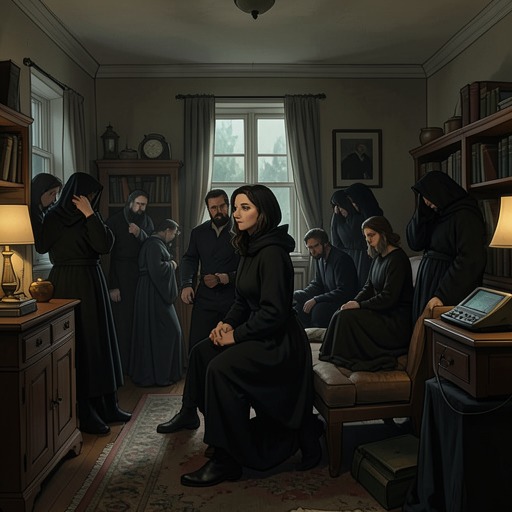
That night she searches the house and discovers how little she owns: mostly old junk scattered on the floor, replaceable with boxes, rags, and imagination. A handful of objects resist that disposability. She wants to keep the embroidered tablecloth, yellow hat, polka-dot gloves, cat’s-eye sunglasses, old issues of Ecran, articles about Sarita Montiel, and a photograph of herself in drag. The picture shows her in a scalloped lamé mermaid dress, with a chignon, carefully applied makeup, and a slim waist softened by the blurred light of the old image. Looking at it, she persuades herself that she was almost beautiful. In the evacuation, these things are not merely luggage: they hold fragments of a self she does not want the threatened disappearance of her home to erase.
By dawn the three-story corner house has become, in the narration’s image, a lifeless cavern. She has burned scraps bearing telephone numbers and addresses, swept up footprints, washed the windows, and dusted surfaces in case fingerprints remain. Only after this frantic work are her dearest possessions packed into two bags. Her preparations transform the house from a lived-in place into a space scrubbed of evidence, while the bags mark the small portion of her past she can carry away.
La Rana and the Road to the Coast
Before leaving, the Queen visits La Rana, who is half asleep and wrapped in a shawl. She asks her friend to keep her things and gives her unfinished work to complete for extra money. She also leaves her radio, telling La Rana she may use anything else. La Rana cannot understand why she would leave such a beautiful house and presses her to explain. The Queen can only say that she must go because it is a matter of life and death. When the car horn interrupts them again, she loosens La Rana’s grip, hugs and kisses her, and calls her “Mama Rana,” the affectionate name she sometimes uses.
The farewell is made more difficult by the Queen’s suspicion that the people arranging the escape do not trust her. On the road, Laura asks whether she told La Rana anything and warns that the friend’s knowledge could put him at risk. The Queen angrily rejects the implication that people like her are traitors, although she says she told La Rana nothing, for his own protection. The exchange brings political secrecy into conflict with the Queen’s bonds of friendship: protecting La Rana requires withholding an explanation, even as the abrupt departure leaves him bewildered.
Laura drives her toward Viña del Mar with a young man at the wheel. Their silence and Laura’s repeated cigarettes, lit at toll stops and stubbed out without being smoked, sharpen the tension of the journey. The Queen reads the road signs and realizes where they are going, then tries to treat the trip lightly, remarking that sea air may help her complexion. Viña appears as a resort of Mediterranean-style mansions, but in the early morning the Queen sees domestic servants on their way to the shops, schoolchildren in Catholic uniforms, and an old woman in a wheelchair beneath a jasmine-covered pergola. The unfamiliar resort brings into the escape a landscape she has never visited, while her recollection of a free day at the working-class beach in Cartagena links the present journey to an earlier experience of collective access and pleasure.
At Viña, she again asks when she will see Carlos, reminding Laura that this was their agreement. Laura promises that they will take care of it, then instructs her to enter a café beside the beach alone, sit at the first table on the left, order something, and wait without speaking to anyone. The Queen objects that coffee is bad for her ulcer; Laura tells her to order something else. Before the car leaves, Laura apologizes for having been rude and gives her a quick kiss on the cheek. The brief gesture softens, without resolving, the distance between the suspicious passenger and the young organizer responsible for taking her to safety.
Left with her bags, the Queen wonders whether the guerrillas have simply removed her from Santiago and abandoned her without money. She finds that she has too little even to manage in this wealthy beach town. A waiter invites her into the café and places her at the requested table, from which the sea appears as a vivid blue expanse, almost like a different country where the atrocities being concealed elsewhere have never taken place. The coast offers a striking visual contrast to the danger behind her, but it does not yet tell her whether she has been rescued, stranded, or brought to another waiting point.
Reunion and the Meaning of Departure
Carlos finally appears at the café. Their familiar theatrical banter briefly returns: he calls it his duty to surprise her, and she says that his absence, as well as routine, has tormented her. Beneath the playfulness, however, is the fear that she had thought she would never see him again. Carlos takes her hand under the table but refuses to discuss that fear; they have little time, he says, and he has information to give her. She is content simply to be with him, yet he insists they leave because the café is full of spies. Picking up her bags, he hurries her outside.
The couple escapes by taxi toward Valparaíso and Laguna Verde. The road is blocked, so the driver proposes going around; Carlos accepts the longer route. During the trip he repeatedly silences the Queen with a finger to his lips, and she follows his lead rather than asking what information he has brought. In Valparaíso, their taxi stops at a red light near the new Parliament building. The Queen whispers that it looks like a hospital for politics; Carlos suppresses his laughter and again signals for silence. Even their private jokes must yield to surveillance and the need to avoid notice.
At Laguna Verde, the Queen’s fear gives way for a moment to astonishment at the landscape. After recoiling from the garbage-filled ravines on the back side of the port, she sees the small coastal inlet and calls it gorgeous, as if it were not even Chile. Carlos answers that Chileans do not know their own country, and the taxi driver agrees. The contrast between the ravines and the beach makes the arrival feel like a release, but the escape remains arranged around caution: Carlos pays the driver and asks him to return at five, while the Queen and Carlos are left together on a nearly deserted shore.
The Queen runs toward the surf, throws off her shoes, and removes the pretend clips holding back her imaginary hair. She wants the landscape to wrap around her and cool the fire of her troubled soul. Carlos follows, and when a small wave wets her feet, they embrace, tumble, laugh, and roll together in the sand. Their physical closeness answers, briefly and without explanation, the separation that has governed the evacuation. Panting beside one another, the Queen says she wishes she could die before waking; Carlos replies that, if she did, he would live forever in a dream. The scene ends not with a guarantee of safety or a settled future, but with the lovers momentarily finding one another in a landscape reached by flight.